> ## Documentation Index
> Fetch the complete documentation index at: https://docs-staging-actions-triggers-prototype.mintlify.site/llms.txt
> Use this file to discover all available pages before exploring further.
> Learn how to rotate an application's client secret using the Auth Dashboard or the Management API.
# Rotate Client Secrets
export const AuthCodeGroup = ({children, dropdown}) => {
const [processedChildren, setProcessedChildren] = useState(children);
useEffect(() => {
let unsubscribe = null;
function init() {
unsubscribe = window.autorun(() => {
const processChildren = node => {
if (typeof node === "string") {
let processedNode = node;
for (const [key, value] of window.rootStore.variableStore.values.entries()) {
const escapedKey = key.replaceAll(/[.*+?^${}()|[\]\\]/g, (String.raw)`\$&`);
processedNode = processedNode.replaceAll(new RegExp(escapedKey, "g"), value);
}
return processedNode;
} else if (Array.isArray(node)) {
return node.map(processChildren);
} else if (node && node.props && node.props.children) {
return {
...node,
props: {
...node.props,
children: processChildren(node.props.children)
}
};
}
return node;
};
setProcessedChildren(processChildren(children));
});
}
if (window.rootStore) {
init();
} else {
window.addEventListener("adu:storeReady", init);
}
return () => {
window.removeEventListener("adu:storeReady", init);
unsubscribe?.();
};
}, [children]);
return {processedChildren};
};
export const AuthCodeBlock = ({filename, icon, language, highlight, children}) => {
const [displayText, setDisplayText] = useState(children);
const [copyText, setCopyText] = useState(children);
const wrapperRef = React.useRef(null);
useEffect(() => {
let unsubscribe = null;
function init() {
if (!window.autorun || !window.rootStore) {
return;
}
unsubscribe = window.autorun(() => {
let processedChildrenForDisplay = children;
let processedChildrenForCopy = children;
for (const [key, value] of window.rootStore.variableStore.values.entries()) {
const escapedKey = key.replaceAll(/[.*+?^${}()|[\]\\]/g, (String.raw)`\$&`);
let displayValue = value;
if (key === "{yourClientSecret}" && value !== "{yourClientSecret}") {
displayValue = value.substring(0, 3) + "*****MASKED*****";
}
processedChildrenForDisplay = processedChildrenForDisplay.replaceAll(new RegExp(escapedKey, "g"), displayValue);
processedChildrenForCopy = processedChildrenForCopy.replaceAll(new RegExp(escapedKey, "g"), value);
}
setDisplayText(processedChildrenForDisplay);
setCopyText(processedChildrenForCopy);
});
}
if (window.rootStore) {
init();
} else {
window.addEventListener("adu:storeReady", init);
}
return () => {
window.removeEventListener("adu:storeReady", init);
unsubscribe?.();
};
}, [children]);
useEffect(() => {
if (!wrapperRef.current) return;
const originalWriteText = navigator.clipboard.writeText.bind(navigator.clipboard);
let isOverriding = false;
const handleClick = e => {
const button = e.target.closest('[data-testid="copy-code-button"]');
if (!button || !wrapperRef.current.contains(button)) return;
isOverriding = true;
navigator.clipboard.writeText = text => {
if (isOverriding) {
isOverriding = false;
navigator.clipboard.writeText = originalWriteText;
return originalWriteText(copyText);
}
return originalWriteText(text);
};
setTimeout(() => {
if (isOverriding) {
isOverriding = false;
navigator.clipboard.writeText = originalWriteText;
}
}, 100);
};
const wrapper = wrapperRef.current;
wrapper.addEventListener('click', handleClick, true);
return () => {
wrapper.removeEventListener('click', handleClick, true);
if (navigator.clipboard.writeText !== originalWriteText) {
navigator.clipboard.writeText = originalWriteText;
}
};
}, [copyText]);
return
{displayText}
;
};
You can change an application's client secret using the Auth0 Dashboard or the Auth0 Management API. When you rotate a client secret, you must update any authorized applications with the new value.
Client secrets should not be stored in public client applications. To learn more, read [Confidential and Public Applications.](/docs/get-started/applications/confidential-and-public-applications)
New secrets may be delayed up to thirty seconds while rotating. To minimize downtime, we suggest you store the new client secret in your application's code/system configuration as a fallback to the previous secret. This way, if the client application request doesn't work with the old secret, your app will use the new secret.
Secrets can be stored in a list (or similar structure) until they're no longer needed. Once you're sure that an old secret is obsolete, you can remove its value from your app's code.
## Use the Dashboard
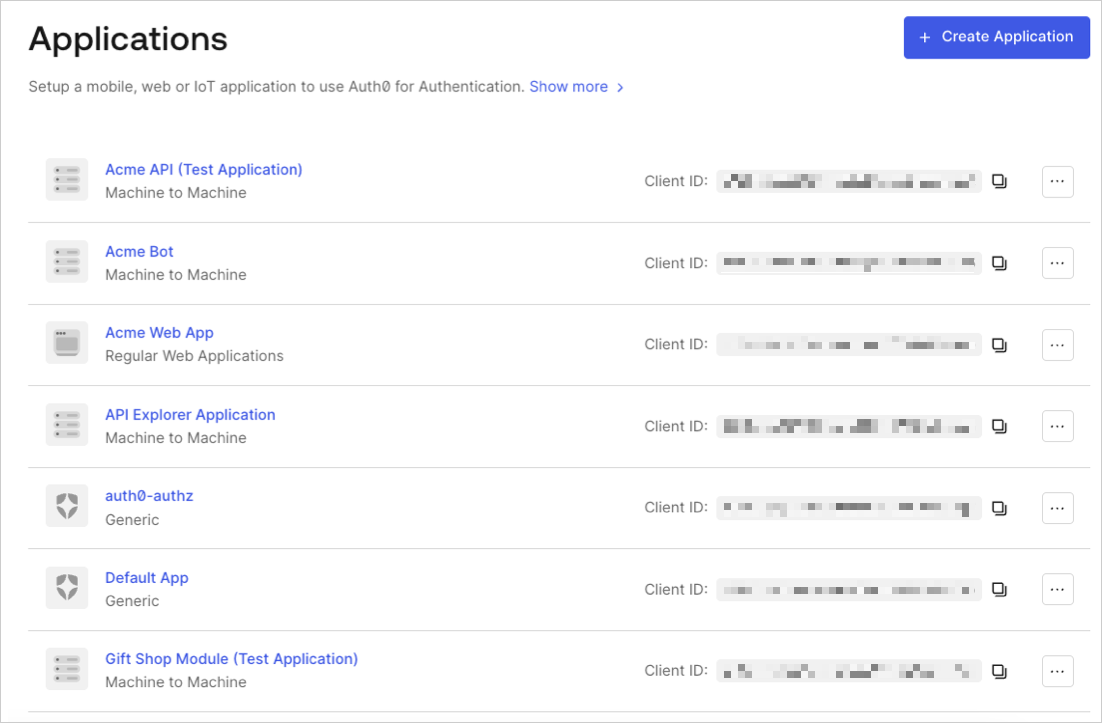
1. In the Auth0 Dashboard, go to [Applications > Applications](https://manage.auth0.com/#/applications), and then select the name of the application to view.
 2. Scroll to the bottom of the **Settings** page, locate the **Danger Zone**, select **Rotate**, and confirm.
3. Scroll to the top of the page, and switch to the **Credentials** tab.
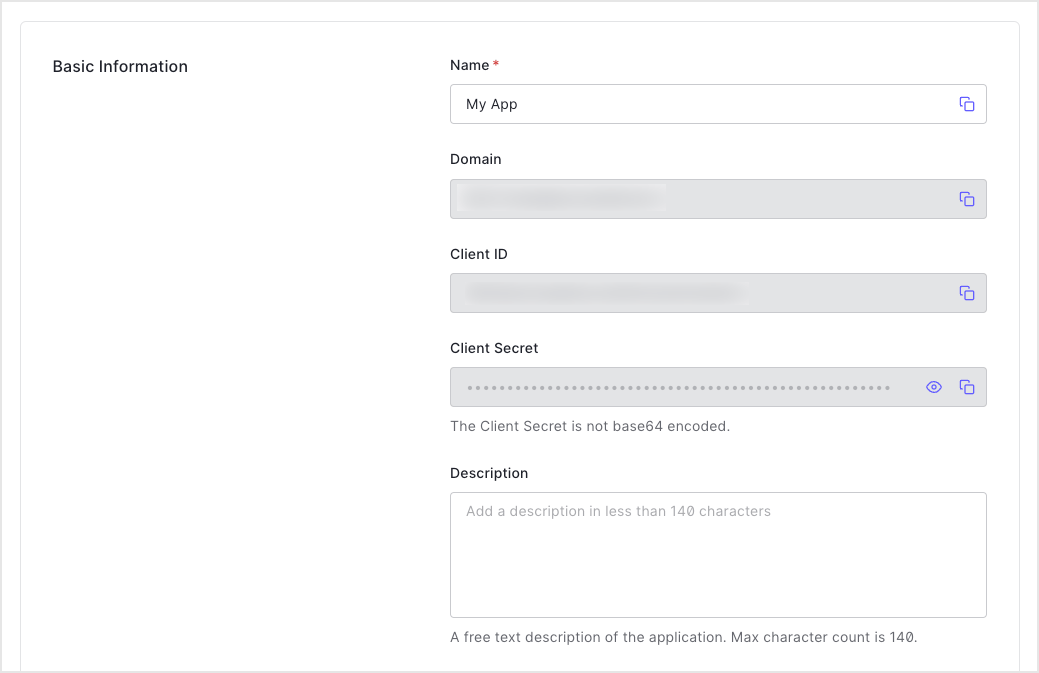
4. View your new secret by locating **Client Secret**, and selecting the eye icon.
2. Scroll to the bottom of the **Settings** page, locate the **Danger Zone**, select **Rotate**, and confirm.
3. Scroll to the top of the page, and switch to the **Credentials** tab.
4. View your new secret by locating **Client Secret**, and selecting the eye icon.
 5. Update authorized applications with the new value.
## Use the Management API
1. Call the Management API [Rotate a client secret](https://auth0.com/docs/api/management/v2#!/Clients/post_rotate_secret) endpoint. Replace the `{yourClientId}` and `MGMT_API_ACCESS_TOKEN` placeholder values with your client ID and Management API access token, respectively.
```bash cURL theme={null}
curl --request POST \
--url 'https://{yourDomain}/api/v2/clients/%7ByourClientId%7D/rotate-secret' \
--header 'authorization: Bearer {yourMgmtApiAccessToken}'
```
```csharp C# theme={null}
var client = new RestClient("https://{yourDomain}/api/v2/clients/%7ByourClientId%7D/rotate-secret");
var request = new RestRequest(Method.POST);
request.AddHeader("authorization", "Bearer {yourMgmtApiAccessToken}");
IRestResponse response = client.Execute(request);
```
```go Go theme={null}
package main
import (
"fmt"
"net/http"
"io/ioutil"
)
func main() {
url := "https://{yourDomain}/api/v2/clients/%7ByourClientId%7D/rotate-secret"
req, _ := http.NewRequest("POST", url, nil)
req.Header.Add("authorization", "Bearer {yourMgmtApiAccessToken}")
res, _ := http.DefaultClient.Do(req)
defer res.Body.Close()
body, _ := ioutil.ReadAll(res.Body)
fmt.Println(res)
fmt.Println(string(body))
}
```
```java Java theme={null}
HttpResponse response = Unirest.post("https://{yourDomain}/api/v2/clients/%7ByourClientId%7D/rotate-secret")
.header("authorization", "Bearer {yourMgmtApiAccessToken}")
.asString();
```
```javascript Node.JS theme={null}
var axios = require("axios").default;
var options = {
method: 'POST',
url: 'https://{yourDomain}/api/v2/clients/%7ByourClientId%7D/rotate-secret',
headers: {authorization: 'Bearer {yourMgmtApiAccessToken}'}
};
axios.request(options).then(function (response) {
console.log(response.data);
}).catch(function (error) {
console.error(error);
});
```
```php PHP theme={null}
$curl = curl_init();
curl_setopt_array($curl, [
CURLOPT_URL => "https://{yourDomain}/api/v2/clients/%7ByourClientId%7D/rotate-secret",
CURLOPT_RETURNTRANSFER => true,
CURLOPT_ENCODING => "",
CURLOPT_MAXREDIRS => 10,
CURLOPT_TIMEOUT => 30,
CURLOPT_HTTP_VERSION => CURL_HTTP_VERSION_1_1,
CURLOPT_CUSTOMREQUEST => "POST",
CURLOPT_HTTPHEADER => [
"authorization: Bearer {yourMgmtApiAccessToken}"
],
]);
$response = curl_exec($curl);
$err = curl_error($curl);
curl_close($curl);
if ($err) {
echo "cURL Error #:" . $err;
} else {
echo $response;
}
```
```python Python theme={null}
import http.client
conn = http.client.HTTPSConnection("")
headers = { 'authorization': "Bearer {yourMgmtApiAccessToken}" }
conn.request("POST", "/{yourDomain}/api/v2/clients/%7ByourClientId%7D/rotate-secret", headers=headers)
res = conn.getresponse()
data = res.read()
print(data.decode("utf-8"))
```
```ruby Ruby theme={null}
require 'uri'
require 'net/http'
require 'openssl'
url = URI("https://{yourDomain}/api/v2/clients/%7ByourClientId%7D/rotate-secret")
http = Net::HTTP.new(url.host, url.port)
http.use_ssl = true
http.verify_mode = OpenSSL::SSL::VERIFY_NONE
request = Net::HTTP::Post.new(url)
request["authorization"] = 'Bearer {yourMgmtApiAccessToken}'
response = http.request(request)
puts response.read_body
```
| Value | Description |
| ----------------------- | ---------------------------------------------------------------------------------------------------------------------------- |
| `{yourClientId}` | Τhe ID of the application to be updated. |
| `MGMT_API_ACCESS_TOKEN` | [Access Tokens for the Management API](https://auth0.com/docs/api/management/v2/tokens) with the scope `update:client_keys`. |
2. Update authorized applications with the new value.
### Set a custom client secret
You can use the Management API [Update a client](https://auth0.com/docs/api/management/v2/#!/Clients/patch_clients_by_id) endpoint to to set a client secret manually instead of requesting a rotation to an automatically generated secret. Your application is configured with the future secret as a fallback ahead of the actual rotation.
```bash lines theme={null}
curl --request PATCH \
--url https://{TenantDomain}/api/v2/clients/{ClientID} \
--header 'Authorization: Bearer {AccessToken}' \
--header 'Content-Type: application/json' \
--data '{
"client_secret": "{CustomClientSecret}"
}'
```
## Learn more
* [View Signing Certificates](/docs/get-started/tenant-settings/signing-keys/view-signing-certificates)
* [Signing Algorithms](/docs/get-started/applications/signing-algorithms)
* [Change Application Signing Algorithms](/docs/get-started/applications/change-application-signing-algorithms)
5. Update authorized applications with the new value.
## Use the Management API
1. Call the Management API [Rotate a client secret](https://auth0.com/docs/api/management/v2#!/Clients/post_rotate_secret) endpoint. Replace the `{yourClientId}` and `MGMT_API_ACCESS_TOKEN` placeholder values with your client ID and Management API access token, respectively.
```bash cURL theme={null}
curl --request POST \
--url 'https://{yourDomain}/api/v2/clients/%7ByourClientId%7D/rotate-secret' \
--header 'authorization: Bearer {yourMgmtApiAccessToken}'
```
```csharp C# theme={null}
var client = new RestClient("https://{yourDomain}/api/v2/clients/%7ByourClientId%7D/rotate-secret");
var request = new RestRequest(Method.POST);
request.AddHeader("authorization", "Bearer {yourMgmtApiAccessToken}");
IRestResponse response = client.Execute(request);
```
```go Go theme={null}
package main
import (
"fmt"
"net/http"
"io/ioutil"
)
func main() {
url := "https://{yourDomain}/api/v2/clients/%7ByourClientId%7D/rotate-secret"
req, _ := http.NewRequest("POST", url, nil)
req.Header.Add("authorization", "Bearer {yourMgmtApiAccessToken}")
res, _ := http.DefaultClient.Do(req)
defer res.Body.Close()
body, _ := ioutil.ReadAll(res.Body)
fmt.Println(res)
fmt.Println(string(body))
}
```
```java Java theme={null}
HttpResponse response = Unirest.post("https://{yourDomain}/api/v2/clients/%7ByourClientId%7D/rotate-secret")
.header("authorization", "Bearer {yourMgmtApiAccessToken}")
.asString();
```
```javascript Node.JS theme={null}
var axios = require("axios").default;
var options = {
method: 'POST',
url: 'https://{yourDomain}/api/v2/clients/%7ByourClientId%7D/rotate-secret',
headers: {authorization: 'Bearer {yourMgmtApiAccessToken}'}
};
axios.request(options).then(function (response) {
console.log(response.data);
}).catch(function (error) {
console.error(error);
});
```
```php PHP theme={null}
$curl = curl_init();
curl_setopt_array($curl, [
CURLOPT_URL => "https://{yourDomain}/api/v2/clients/%7ByourClientId%7D/rotate-secret",
CURLOPT_RETURNTRANSFER => true,
CURLOPT_ENCODING => "",
CURLOPT_MAXREDIRS => 10,
CURLOPT_TIMEOUT => 30,
CURLOPT_HTTP_VERSION => CURL_HTTP_VERSION_1_1,
CURLOPT_CUSTOMREQUEST => "POST",
CURLOPT_HTTPHEADER => [
"authorization: Bearer {yourMgmtApiAccessToken}"
],
]);
$response = curl_exec($curl);
$err = curl_error($curl);
curl_close($curl);
if ($err) {
echo "cURL Error #:" . $err;
} else {
echo $response;
}
```
```python Python theme={null}
import http.client
conn = http.client.HTTPSConnection("")
headers = { 'authorization': "Bearer {yourMgmtApiAccessToken}" }
conn.request("POST", "/{yourDomain}/api/v2/clients/%7ByourClientId%7D/rotate-secret", headers=headers)
res = conn.getresponse()
data = res.read()
print(data.decode("utf-8"))
```
```ruby Ruby theme={null}
require 'uri'
require 'net/http'
require 'openssl'
url = URI("https://{yourDomain}/api/v2/clients/%7ByourClientId%7D/rotate-secret")
http = Net::HTTP.new(url.host, url.port)
http.use_ssl = true
http.verify_mode = OpenSSL::SSL::VERIFY_NONE
request = Net::HTTP::Post.new(url)
request["authorization"] = 'Bearer {yourMgmtApiAccessToken}'
response = http.request(request)
puts response.read_body
```
| Value | Description |
| ----------------------- | ---------------------------------------------------------------------------------------------------------------------------- |
| `{yourClientId}` | Τhe ID of the application to be updated. |
| `MGMT_API_ACCESS_TOKEN` | [Access Tokens for the Management API](https://auth0.com/docs/api/management/v2/tokens) with the scope `update:client_keys`. |
2. Update authorized applications with the new value.
### Set a custom client secret
You can use the Management API [Update a client](https://auth0.com/docs/api/management/v2/#!/Clients/patch_clients_by_id) endpoint to to set a client secret manually instead of requesting a rotation to an automatically generated secret. Your application is configured with the future secret as a fallback ahead of the actual rotation.
```bash lines theme={null}
curl --request PATCH \
--url https://{TenantDomain}/api/v2/clients/{ClientID} \
--header 'Authorization: Bearer {AccessToken}' \
--header 'Content-Type: application/json' \
--data '{
"client_secret": "{CustomClientSecret}"
}'
```
## Learn more
* [View Signing Certificates](/docs/get-started/tenant-settings/signing-keys/view-signing-certificates)
* [Signing Algorithms](/docs/get-started/applications/signing-algorithms)
* [Change Application Signing Algorithms](/docs/get-started/applications/change-application-signing-algorithms)